
Connect an AI tool to Mitti
Connect Claude or another AI client to the Mitti MCP server and ask questions of your Mitti data.
The Mitti MCP server is in Early Access. Contact your customer success manager to see if your organization is eligible.
What is the Mitti MCP server?
Mitti runs as a Model Context Protocol (MCP) server. MCP is an open standard that lets an AI client read data from another system through a defined set of tools. A client that supports remote MCP over OAuth 2.0 can query Mitti on your behalf, carrying your own access rather than an administrator's. This removes the export step. Rather than pulling Mitti data into a spreadsheet and pasting it into a chat, you ask the question in the client you already use, and it reads current data.
How does access work?
The connection is read-only. An AI client can look data up in Mitti, and it cannot create, edit, or delete anything.
What the client can see is bounded by your own Mitti permissions. Mitti filters the available tools against the permissions you already hold, so the client never reaches data you could not open yourself in the web app. Two people who connect the same client can get different answers.
A connection reads one organization. If you belong to more than one, you choose which one when you sign in, and the connection stays with that organization. To read a second organization, set up a second connection.
Data the client reads leaves Mitti. Anything it retrieves becomes part of that conversation with your AI provider, under whatever agreement you hold with them.
Administrators cannot see which users have connected, and cannot approve or block a connection. Tools also appear individually in your client rather than grouped by product area. Content is available in US English only.
Requirements
- Mitti Premium or Enterprise Plan
- Full seat
- Mitti MCP server available for your organization
- An AI client that supports remote MCP over OAuth 2.0
- Browser to sign in
1. Request access for your organization
Contact Mitti Support and ask for the Mitti MCP server to be turned on for your organization. Access is granted per organization, so you cannot turn it on yourself.
Wait for Support to confirm before you continue. A client that connects before access is granted receives no tools.
2. Add Mitti to your AI client
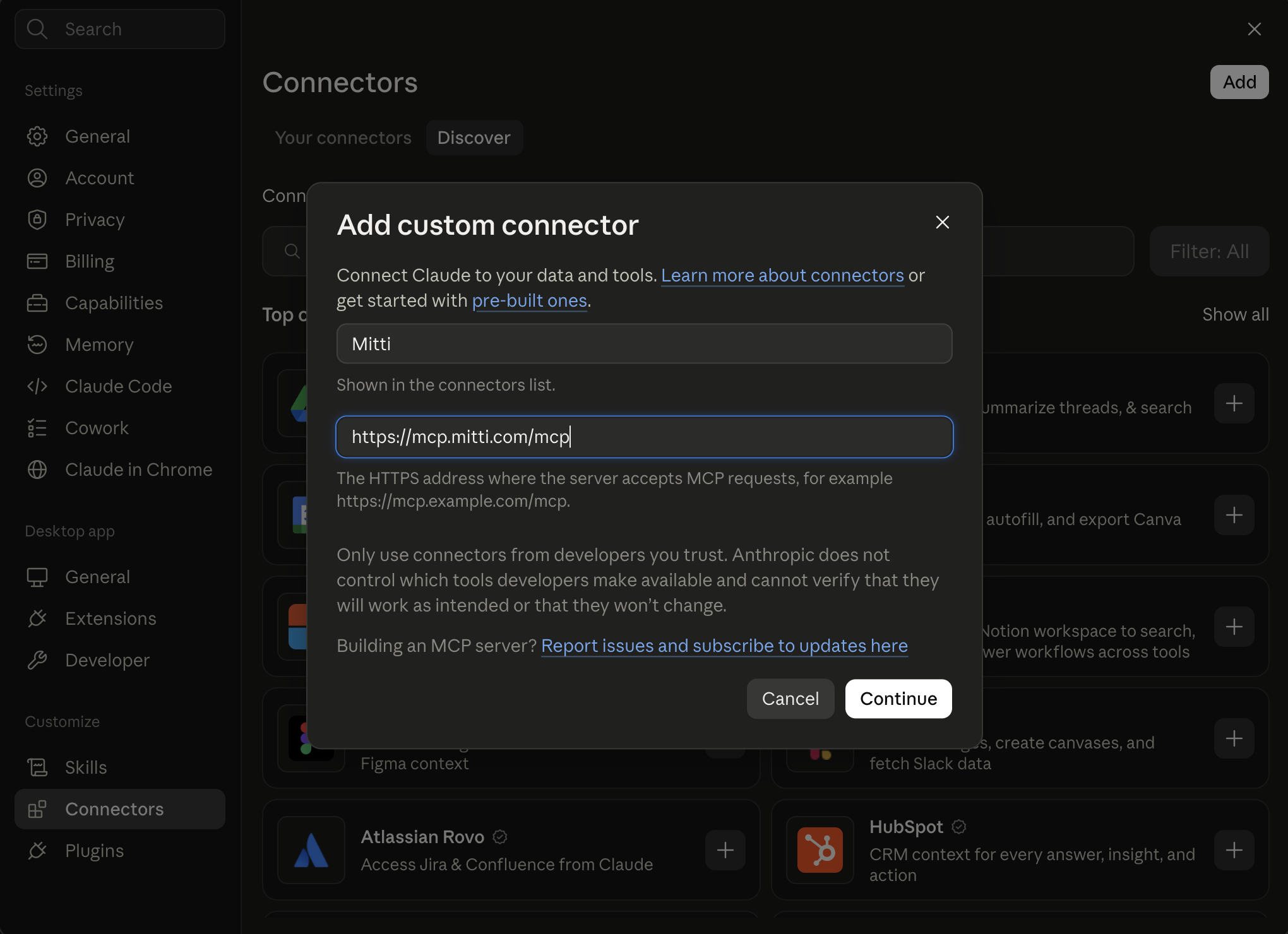
Add Mitti as a custom remote MCP server, using https://mcp.mitti.com/mcp as the server address. Where you enter it depends on the client.
Claude Desktop
-
Open Settings, then select Connectors.
-
Select Add.
-
Enter a name and the server address, then select Continue.
-
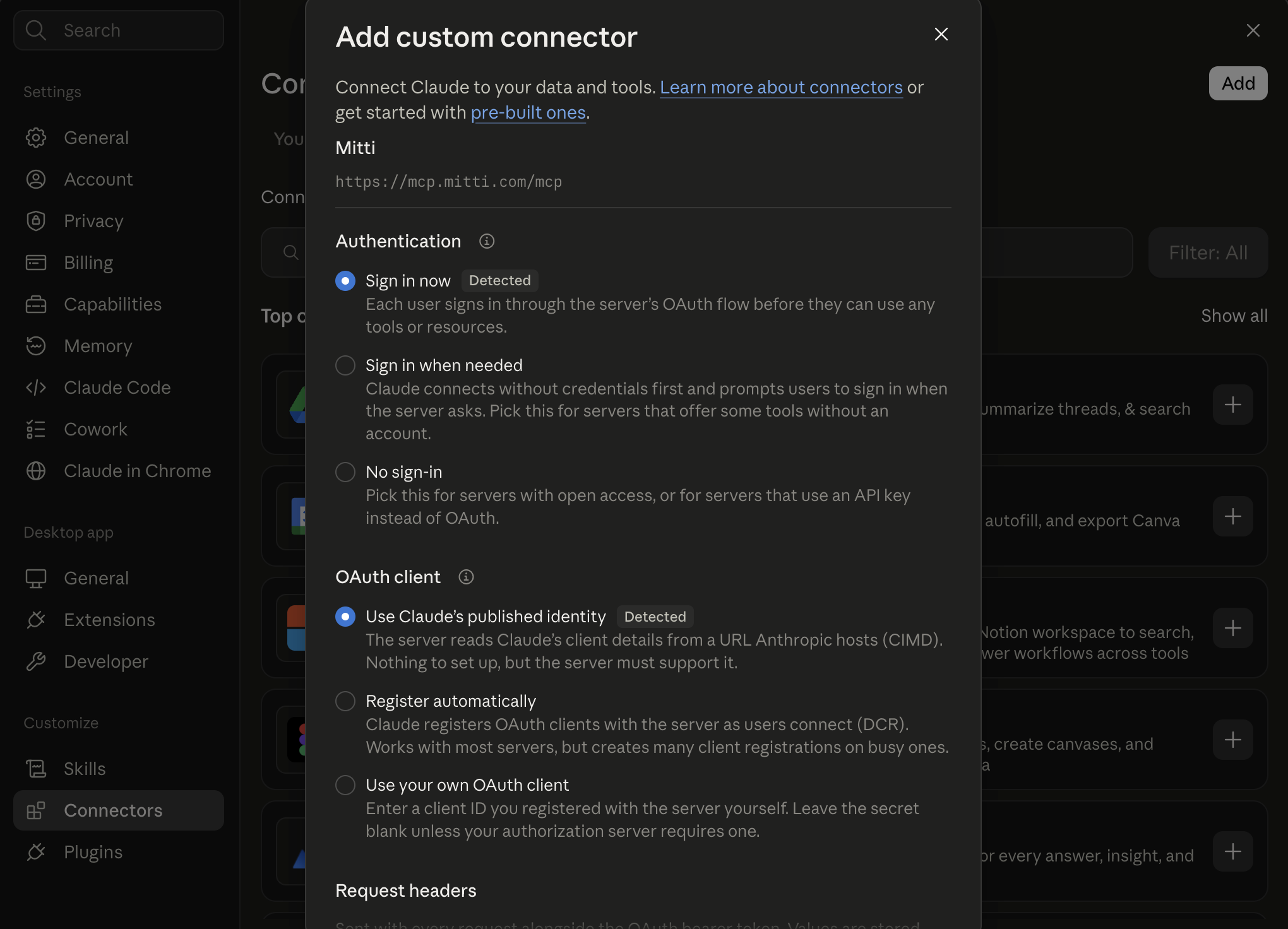
Accept the authentication and OAuth client options Claude detects.
Claude Code
Run the following command:
claude mcp add --transport http mitti https://mcp.mitti.com/mcpAnother client
Enter the same server address wherever the client asks for a remote MCP server.
3. Sign in and choose your organization
-
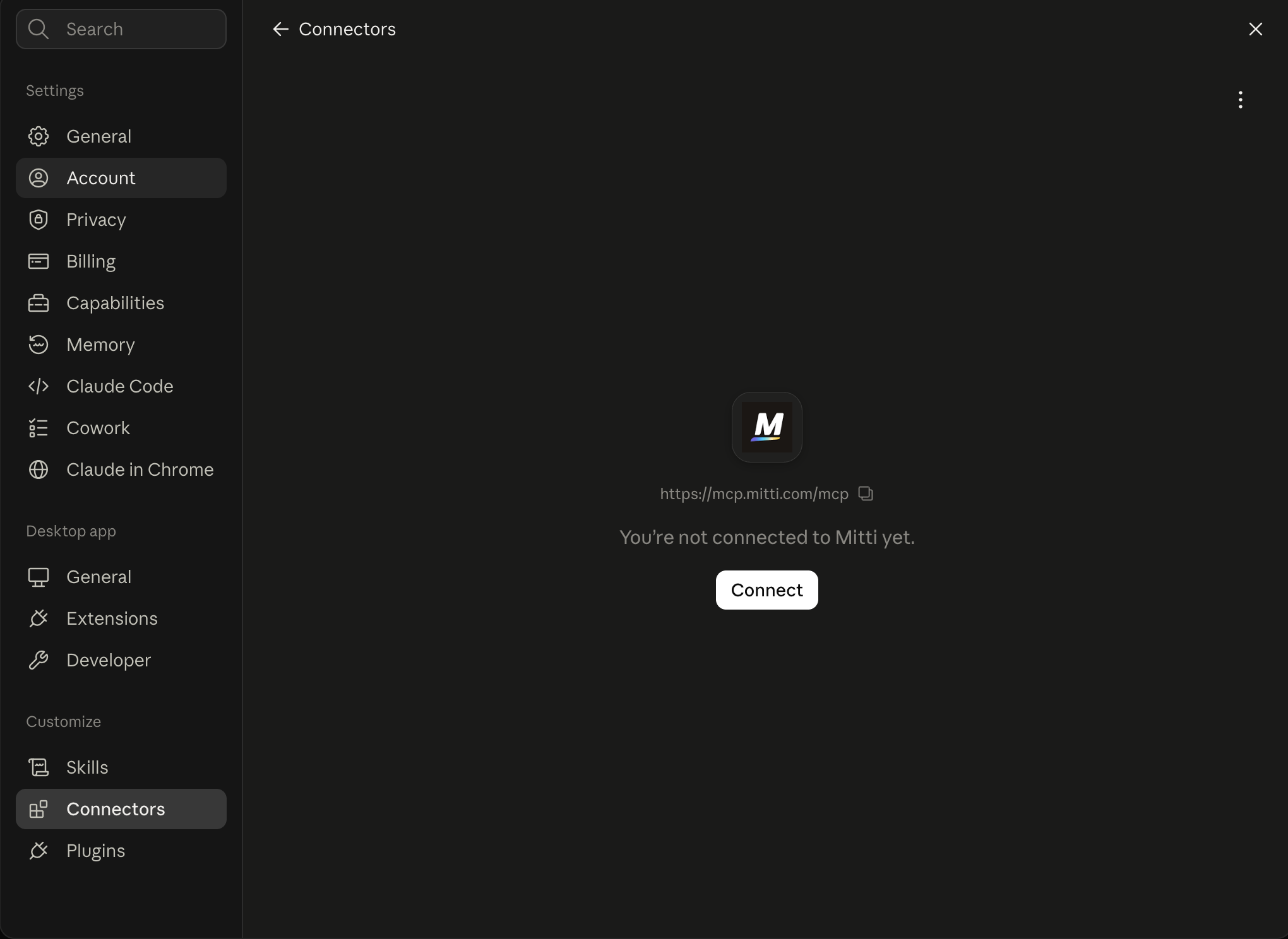
Select Connect. Mitti opens a sign-in page in your browser.
-
Sign in the way you sign in to Mitti, including through your company's single sign-on (SSO). A consent screen then names the client and asks you to confirm. If you belong to more than one organization, choose one on this screen.
-
Mitti issues the client a token scoped to that one connection. Your Mitti password and API tokens are never passed to the client.
4. Verify the connection
- Ask the client to list the Mitti tools it can use. A list of tool names confirms the connection works.
- Ask one question you can check against the Mitti web app, so you confirm the client is reading your data rather than guessing. The client names the Mitti tool it used, then returns a figure that matches the same view in the web app.
If you set up the local Mitti connector before September 2026, revoke its API token once this connection works. See Move from the local connector.
Which Mitti data can you ask about?
The server exposes a read-only subset of Mitti's tool registry, covering the areas below. Which tools you see depends on the permissions you hold.
What you can do
- Look up inspections and their responses, filtered by template, site, date range, or who completed them.
- Review actions, including assignee, status, and which ones are overdue.
- Read issues raised in your organization, including category, site, and status.
- Look up assets and their details, including asset type and the site each one belongs to.
- Check inspection schedules, including what is due and what has been missed.
- Read training records, including course completions and progress for the people you can already see.
- Look up your organization's sites and groups, and who belongs to them.
Some capabilities depend on the permissions you hold, so a team member may see tools you do not. If a capability you expect is missing, ask your Mitti administrator to review your permissions.
Example prompts
"How many inspections were completed at each site last month?"
"Which actions assigned to the maintenance team are overdue?"
"What are the most common issue categories raised in the last 90 days?"
"Which assets at the Brisbane site are due for service?"
"Summarize the failed responses in last week's forklift pre-start inspections."
Your AI client may let you turn individual tools on or off, or ask you to approve a tool before it runs. Those controls belong to the client rather than to Mitti, so check its own documentation.
Move from the local connector
The earlier Mitti connector ran on your own machine, needed Node.js, and used a user API token that you pasted into a configuration file. This connection replaces it, and the token is worth attention because a user API token carries full read and write access to the Mitti API.
- Set up the connection and verify it works.
- Remove the Mitti entry from your client's local MCP configuration.
- Revoke the user API token you created for the local connector.
Disconnect an AI client
To end a connection, remove Mitti from the connectors or MCP servers list in your AI client. The client's access to Mitti ends at that point.
A connection you leave in place expires after 30 days after inactivity. When it expires, your client asks you to sign in again. Ending a connection does not sign you out of Mitti anywhere else.
Troubleshooting
| Problem | Cause | Fix |
|---|---|---|
| The client connects, but no Mitti tools appear | The Mitti MCP server is not turned on for your organization | Contact Mitti Support and confirm access was granted |
| A tool you expect is missing | Mitti filters tools by the permissions you hold | Ask your Mitti administrator to review your permissions |
| Answers come from the wrong organization | The connection is bound to the organization you chose at sign-in | Set up a second connection and choose the other organization |
| Sign-in fails and your organization uses SSO | Your identity provider did not complete the round trip | Retry the sign-in, then contact Mitti Support if it fails again |
Relevant articles
Use the Mitti API to connect Mitti with your systems, retrieve data, and automate workflows.
Learn how to generate and revoke user API tokens that are required for integrations with Mitti.
Learn about Early Access and Preview features, and see which Mitti features are currently available in each stage.
Updated about 1 hour ago